
When the Sea Remembers: A History of Tulak Balaʼ and Rebo Wekasan Across the Nusantara
CA
How one Wednesday in the Islamic month of Ṣafar came to be marked, in a dozen different ways, from the highlands of Minangkabau to the reefs of Sulu
There is a particular Wednesday every year , the last one before Ṣafar gives way to Rabiʻul Awwal that carries an unusual amount of quiet weight across the Muslim world of maritime Southeast Asia. In Java they call it Rebo Wekasan, "the final Wednesday." In Aceh it is Rabu Habeh or Mano Safa. In the Minangkabau highlands, communities gather for the Ratib Tulak Bala. And far to the east, among the Tausug of the Sulu Archipelago, families walk down to the shore for magduwaa and a communal bath in the sea. Different names, different choreography, sometimes different theology entirely but the same calendrical instinct, repeated across a thousand kilometres of coastline and five centuries of history: something about this day calls for the community to come together, ask for protection, and touch water.
This is a piece about where that instinct came from, and about how strikingly differently it has been expressed as Islam settled into the very different societies of the Nusantara and the southern Philippines.
1. A pre-Islamic anxiety, inherited and reworked
Long before any of these Wednesday rituals existed, the Arabs of the Jāhiliyyah already regarded the month of Ṣafar with dread. It was thought to house a parasite that gnawed at the stomach, or to be a month in which misfortune simply travelled more freely. The Prophet Muhammad ﷺ addressed this directly and, according to the transmission recorded by both al-Bukhārī and Muslim, dismantled it in a single line: "There is no contagion, no bad omen from birds, no ill-omened owl, and no Ṣafar." Later scholars, uncomfortable even repeating the old dread by name, took to calling the month Ṣafar al-Khayr "the good Ṣafar" or Muẓaffar, "the victorious."
And yet the anxiety never fully disappeared; it simply migrated. By the time Islam had taken root across the archipelago and carried by traders, Sunni Sufi orders, and scholars travelling the same monsoon routes that had once carried Hindu-Buddhist cosmology to the same shores , a new belief had attached itself specifically to the last Wednesday of Ṣafar: that on this single night, some 320,000 trials apportioned for the entire year are released from the Preserved Tablet into the world. This figure traces to a report popularised by the Egyptian mystic al-Dairabī and repeated in later devotional compilations, not to any statement of the Prophet ﷺ himself but by the seventeenth and eighteenth centuries it had become so embedded in the religious imagination of the Malay-Indonesian world that entire liturgies, charms, and communal rites grew up around deflecting it.
What is historically interesting is not that this belief lacks a Prophetic source ,Indonesian and Middle Eastern scholars alike have said as much for centuries , but that a single unverified report, travelling along the same trade and pilgrimage networks that carried the Shāfiʻī school and the Sufi orders into the region, could generate such a rich and varied family of local ritual responses. That divergence is the real subject of this history.
2. Java: the scholar's response — prayer, verses, and a fatwā that refused to bend
In Java, the response to the last-Wednesday belief took a distinctly textual, scholarly form, which makes sense given the island's dense network of pesantren and its centuries-old absorption into the wider Shāfiʻī scholarly world.
Two devotional technologies emerged. The first was a specific four-rakʻah prayer, popularly known as Ṣalāt Rebo Wekasan or Ṣalāt Ṣafar. The second, recorded by the great nineteenth-century Bantenese scholar Syaikh Nawawi al-Bantani in his commentary Nihāyat al-Zayn, involved writing out seven Qurʼānic verses containing the word salām drawn from Sūrah Yā-Sīn, al-Ṣāffāt, al-Zumar, and al-Qadr then dissolving the ink in water, and drinking it as a protective act.
What makes the Javanese case historically distinctive is that it produced one of the clearest recorded fatwā disputes anywhere in the Nusantara on this subject. KH Hasyim Asyʻari, founder of Nahdlatul Ulama, was asked directly about Ṣalāt Rebo Wekasan and answered, in an archived ruling still held by NU Sidoarjo, that neither this prayer nor the related "gift prayer" had any foundation in the sharʻ , noting pointedly that none of the authoritative Shāfiʻī reference works, from al-Taqrīb up through the Iḥyāʼ ʻUlūm al-Dīn, mention it at all, and that a genuinely sound practice would surely have been recorded by scholars of that calibre. A more accommodating voice, the Meccan-based Shaykh ʻAbd al-Ḥamīd Quds al-Makkī, offered a workaround still cited by Indonesian scholars today: perform the same prayer, but with the intention of ordinary voluntary prayer rather than a rite tied to the date itself since unrestricted supererogatory prayer is valid at any hour.
This is, historically, the Nusantara at its most "bookish": the dispute is fought out in terms of which classical texts do or do not mention a practice, and the resolution offered is a change of niyyah rather than a change of behaviour. It is a very Javanese solution to a very old anxiety.
3. Aceh: the sea itself as the mechanism of relief
Travel across the Strait of Malacca to Aceh and the entire register changes. Where Java answered the last-Wednesday problem with prayer and script, Aceh answered it , much like the Tausug will, further east with immersion.
The core Acehnese observance, documented by researchers working in Banda Aceh, Aceh Besar, Aceh Timur, Aceh Selatan, and Pidie during the early COVID-19 outbreak, is called tulak bala or, at year's end, Rabu Abeh / Mano Safa or literally, bathing in a river or the sea. Communities gather in the evening, since (as one village chief explained to researchers) that is when people are free from daily labour and can attend together. But underneath this shared calendrical frame, Aceh contains real regional variation. In the southwest, a pawang or a ritual specialist rather than an imam casts a spell resembling the basmalah over limes, whose water is then washed over the faces, hands, and feet of entire families and splashed across the walls of the house, accompanied by amulets of a wood called kayu ibu-ibu hung at the doorway. In the south, onions are eaten as a folk prophylactic, torchlit processions circle the village while Sūrat Yā-Sīn is recited, and an old manuscript called the Mujarrabāt , the very same genre of text behind the 320,000-balāʼ belief is chanted aloud. In the Malay-speaking east, the ritual specialist casts Arabic-Malay incantations over offerings of food, usually chickens, explicitly to summon and appease ancestral spirits.
It is worth pausing on that last detail, because it marks a real historical fault line. Several of the Acehnese researchers' own informants , a lecturer, a nurse, a social activist among them told the field team plainly that they considered parts of the ritual to border on polytheism, or to have nothing to do with authentic Islamic teaching at all, even as they acknowledged that the practice was too deeply woven into communal life to simply discard. That tension is itself a piece of history: it shows a living, contested boundary between an older animist and Hindu-influenced ritual substrate that includes offerings to spirits, charmed amulets, protective wood and the more purely supplicatory, Qurʼān-centred practice that coexists alongside it in the very same province.
A related but distinct Acehnese tradition, the nocturnal Ratib Berjalan ("Walking Ratib") of Gedung Biara village in Aceh Tamiang, shows how far the region's ritual imagination could run with the same base idea. Men only, dressed in white, walk the length of the village in total darkness where every household light deliberately extinguished behind a shaykh carrying a whip made of bound palm and coconut skewers and a white flag inscribed with the declaration of God's oneness, chanting dhikr as they go, until they reach the shore for a communal feast. Researchers studying the ritual read its symbolism carefully: white for purity of intention, darkness to sharpen concentration in remembrance, and the strictly one-directional, seaward movement as the ritual "sweeping" of misfortune toward the ocean, which the community believes absorbs it.
4. Minangkabau: a ritual repurposed as a tool of conversion
The Minangkabau case, centred on the Ratib Tulak Bala of Guguak Sungai Sariak in Padang Pariaman, adds a layer that neither the Javanese nor Acehnese material foregrounds quite so explicitly: the deliberate use of an existing communal ritual as a vehicle for religious change.
Local oral history, recorded by researchers working with village elders (niniak mamak, labai, and tuanku), holds that the ratib tulak bala tradition practitioners overwhelmingly belong to the Syattariyah Sufi order and was first established as a means of drawing the Minangkabau population away from earlier Hindu-influenced belief and toward Islamic tawḥīd. Shaykh Burhanuddin, the scholar credited with spreading the Syattariyah order through the region after his own studies in Aceh, is remembered as having approached this "gently," retaining the outward shape of a pre-existing communal gathering while filling it with distinctly Islamic content: recitation of al-Fātiḥah, Yā-Sīn, Āyat al-Kursī, and collective dhikr, walked as a procession around the village and concluded with communal prayer and a shared meal.
This is a genuinely different historical move from what happened in Java or Aceh. Rather than a scholar issuing a fatwā to correct a practice from the outside (Hasyim Asyʻari), or a practice persisting alongside acknowledged internal tension (Aceh), the Minangkabau tradition presents itself, in its own community memory, as syncretism used strategically, in the direction of orthodoxy rather than away from it , the ritual as a bridge crossed once, in one direction, from an older cosmology into Islam.
A closely related coastal variant, documented among the Minangkabau of Nagari Painan on the west Sumatran coast, shows the ritual's logic evolving again in modern hands: contemporary researchers there describe flower-water and offering sites chosen because they map onto historically flood-prone locations, pre-ritual cooperative labour clearing waterways as genuine hazard mitigation, and oral narratives of past floods and storms recited during the procession as a deliberate, functioning mechanism of intergenerational disaster memory. Whatever one makes of its theology, the ritual there has plainly also become a vehicle of practical community preparedness, a second, entirely secular layer of meaning stacked on top of the religious one.
5. The Malay coast: charms, limes, and the limits of tawakkul
Along the Malay-settled coast of North Sumatra, in villages such as Bagan Serdang in Pantai Labu, the tolak bala tradition takes a form very close to the southwestern Acehnese pattern wherein lime water washed over the body and splashed on the walls of the home, protective amulets bound to a post of the same kayu ibu-ibu wood, believed to bar evil spirits from crossing into the household or the village boundary. What is worth noting historically is how carefully some of the community's own practitioners drew the line around what the ritual could and could not do. One elder interviewed by researchers stated plainly that the charm itself has no power of its own; if Allah has willed a trial for someone, the trial will still come, and human beings are only ever attempting protective effort (ikhtiyār), not commanding an outcome. That is, in miniature, a folk articulation of exactly the theological caution scholars like Hasyim Asyʻari were making from the far more formal register of fiqh as a reminder that "popular religion" and "learned religion" were never as separate in the Nusantara as the labels suggest.
6. The Tausug and the Sama: history at the eastern edge of the same current
By the time this ritual complex reaches the Sulu Archipelago, it has crossed not only geography but a different linguistic and political history altogether , the old Sultanate of Sulu, its own scholarly networks, and its own maritime economy oriented as much toward Brunei, Mindanao, and the wider Sulu Sea as toward Java. And yet the same last-Wednesday-of-Ṣafar (Sappal) instinct surfaces here too, in a form that is, historically, closer to the Acehnese sea-bathing model than to the Javanese prayer-and-script model.
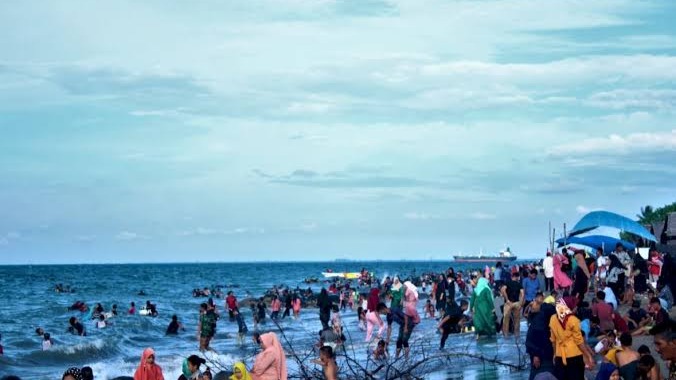
The core Tausug practice is magduwaa kasalamatan: the community gathers, typically under the leadership of the local imam, for collective supplication for peace, security, and protection from balāʼ. At the close of the duʻāʼ, the imam makes the specific intention to release its barakah into the sea, after which the whole congregation goes down to bathe together. The choice of the ocean here is not merely symbolic as practically, it is the only body of water large enough to allow an entire coastal community to be cleansed together at once, a very concrete reason for a very old-looking ritual choice.
The nearest ethnographic parallel is the Pagtulak Balaʼ of the Sama community of Laum Tabawan, documented on film in 2017. There too, the rite falls in Sappal; there too, it opens with communal ritual bathing administered by the imam. But the Sama version then diverges in a historically revealing way: a boat is loaded with food offerings and, in some tellings, effigies symbolically freighted with the village's accumulated misfortune, and set adrift on the open sea. If it drifts back to shore, the community reads this as a sign the offering was insufficient and repeats the rite; any fisherman who later comes across the boat is free to take its provisions, but only after asking permission of the spirits believed to travel with it.
Set side by side, the Tausug and Sama rites make the same historical point that the Acehnese material made in miniature: even within a single narrow strait, between two closely related maritime peoples observing the same month for the same stated reason, one community's ritual remains a duʻāʼ addressed to Allah alone and merely carried, symbolically, on the water while its near neighbour's retains an older substrate of literal offering and negotiation with unseen beings, a vestige of a pre-Islamic cosmology that has been overlaid with, but not fully replaced by, Islamic form. That is not a criticism unique to the Sama; it is the same fault line visible in the pawang-led rites of eastern Aceh and the spirit-summoning food offerings recorded there. It is, in other words, a pattern that repeats itself wherever Islam arrived in the Nusantara-Sulu world by gradual absorption into an existing ritual calendar rather than by wholesale replacement of it.
7. What the comparison actually shows
Laid out side by side like this, the regional variation stops looking random and starts looking like a map of how Islam settled into each society:
Java, with its deep textual and pesantren culture, processed the last-Wednesday anxiety through books , a disputed prayer, a Qurʼānic writing-and-drinking rite, and a formal fatwā literature arguing over which classical manuals do or do not mention it.
Aceh, shaped by a much older layer of animist and Hindu-Buddhist practice and by its own distinct pawang tradition running alongside formal Islamic scholarship, processed it through water and specialists , lime-charms, amulets, and processions whose propriety its own community still visibly debates.
Minangkabau, converted relatively late and largely through the deliberate missionary strategy of the Syattariyah order, processed it through repurposed communal ritual , the same gathering-form, filled with new theological content, remembered locally as a tool that carried the community toward Islam rather than away from it.
The Malay coast shows the same water-and-charm vocabulary as Aceh, but paired with an unusually explicit folk theology of ikhtiyār or effort without presumption of control.
The Tausug and Sama, at the far eastern reach of this whole current, show the clearest surviving split between a fully orthodox supplicatory form (the Tausug magduwaa kasalamatan) and one that still visibly carries an older stratum of spirit-propitiation (the Sama Pagtulak Balaʼ) , sometimes only a few dozen kilometres, and one shared ocean, apart.
None of this variation required a single unified command from any centre. It grew, island by island and strait by strait, out of the same imported anxiety about one Wednesday in Ṣafar, refracted through whatever local scholarly tradition, prior cosmology, and available body of water each community happened to have on hand. That is, in the end, a fairly good working definition of what "Islam in the Nusantara" has always been: not one story, but the same seed germinating differently in a hundred different kinds of soil and, it turns out, in a hundred different kinds of water.
Sources drawn on for this piece include:
the fatwā of KH Hasyim Asyʻari (Tebuireng.co);
the Indonesian Council of Ulama's 2025 statement on Rebo Wekasan;
NU Online Jateng and NU Online Jabar's coverage of the seven-verse and Ṣalāt Rebo Wekasan traditions;
BincangSyariah's survey of the fiqh dispute;
Maidah, Andika & Alif (2026) on Kampung Sambirata, Cibeber;
Manan, Kamarullah, Putra, Saprizal & Salasiyah (2021) on tulak bala in Aceh; Dayanti, Safriandi & Rasyimah (2025) on the Ratib Berjalan of Aceh Tamiang; Nursaid, Rahman & Ningsih (2023) on the Ratib Tulak Bala of Guguak Sungai Sariak; Rosa & Handayani (2025) on Tolak Bala as disaster-risk infrastructure in Nagari Painan;
Sutikno, Kartolo & Fitriani (2019) on charm-wearing in Bagan Serdang;
Kauman Sama's 2017 documentation of Pagtulak Balaʼ in Tabawan (Sinama.org); and Maulina, Aklima, Saputra & da Silva (2025) on the Tulak Bala tradition more broadly.